
Ariel Miller’s Fish Tales

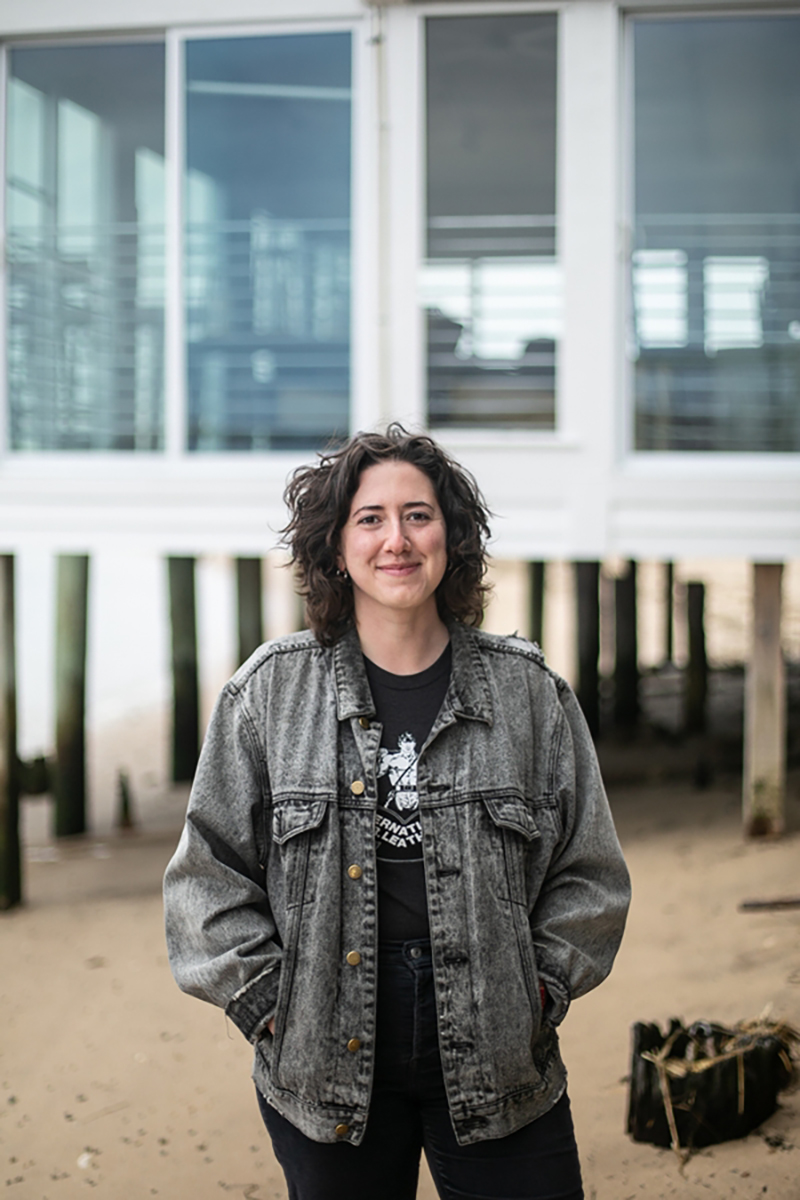
Writer Ariel Miller in Provincetown. Photo: Agata Storer
To write The Arowana, her novel in progress, Ariel Miller leaned into her knowledge of the niche world of aquarium enthusiasts, an online community she’d followed with interest for years. The book, a coming-of-age story about a young woman who stumbles into a career as a wildlife trafficker, has required extensive research on endangered fish — specifically arowana, a rare tropical freshwater creature that’s highly prized among collectors. When she began her research in 2024, Miller traveled to Buffalo, N.Y. to interview the owner of a reptile store who told her about a customer intending to sell an arowana for $20,000.
“In my mind, there’s a circle around fishkeeping, conspicuous consumption, masculinity, ferality, illegality, fear, and desire,” says Miller. “I’m not actually a fish person myself, but I think that fear or repulsion was why I got really intrigued.”
The protagonist in The Arowana, Jude, displays a similar ambivalence, simultaneously mesmerized and disgusted when taking care of an aquarium owned by her friend Lincoln. “She uncapped foul-smelling food pellets and unzipped bags of frozen bloodworms,” Miller writes of Jude. “The worms and pellets drifted down from the surface like snow.”
Jude, a recent college graduate, accepts Lincoln’s offer to manage his exotic fish business in Buffalo while he goes on a trip. As the days go by, the aquarium becomes the center of Jude’s world, and her life is reduced to feeding schedules and increasingly long stretches of isolation — that is, until she meets the arowana traffickers and joins their lucrative gambit.
Miller, 31, began The Arowana as an M.F.A. candidate in fiction at Washington University in St. Louis. She’s continued working on the book as a fellow at the Fine Arts Work Center in Provincetown, hoping to produce a 300-page manuscript.
Though the book is halfway done, Miller says working on one project for years is daunting. “I think it’s tipped over to the point where it has momentum to just keep going,” she says. “I am ready to finish it. I want to finish it. I need to get to the other side.” The ending, however, has eluded her. “The novel feels like a pitch-dark warehouse,” she says. “I know approximately how big it is but not the layout. And I’m in there in the dark, with my arms out, bumping into strange objects.”
At least her characters are familiar, Miller says, each one having “some germ of myself in them.” Jude is an amplification of Miller’s own post-college self, riddled with anxiety and paralyzed by thoughts about the future. In the beginning of The Arowana, while Jude is still in school, she sits in her dorm room and googles “Is time subjective?” and “Is a second a real or a made-up thing?”
Miller conjures Jude’s depression using vivid, sensory language that pulls readers under the covers of her twin extra-long bed to convey that consuming existentialism known to many undergraduates past and present. “Jude spent her days in the metallic crush of the present, compacted on either side by the mass of past and future,” Miller writes. “Walls got soggy and bent. Solid surfaces grew fur.”


