
Interview with Second-Year Poetry Fellow Ty Raso

Interview by Daisy St. Sauveur
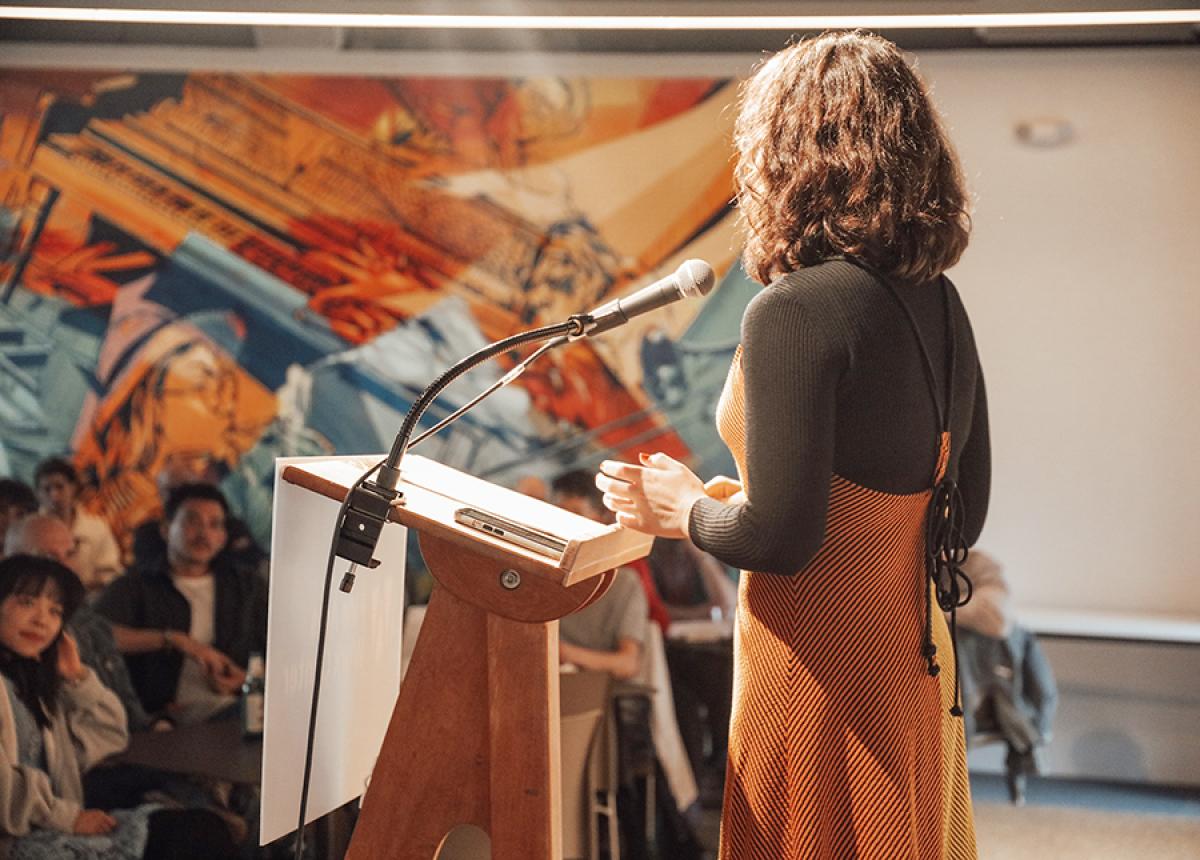
In her debut full-length collection, MIRROR WOULD BE A BEAUTIFUL NAME FOR A CHILD, forthcoming in 2027 from Noemi Press, poet and teacher Ty Raso explores the mirror as both a portal and site of reflection. A two-time Fine Arts Work Center Poetry Fellow (2023–2024 and 2025–2026), Raso’s work navigates the “long and nonlinear” journey of transition, examining how we are gendered by the world and how we might eventually reclaim our own narratives.
In this conversation, FAWC Communications Manager Daisy St. Sauveur speaks with Raso about the structures that provide a “glove” for handling raw personal truths– from the childhood memory of playing Doom with her father to the unexpected poetic resonance of a crying Pikachu.
Daisy St Sauveur: So in your book’s title, MIRROR WOULD BE A BEAUTIFUL NAME FOR A CHILD, the mirror is set up as a major theme throughout the book. It appears both as a “portal made of skin and light” and as something that reflects a bruised face. How does this idea of a mirror shape the book’s story of transformation?
Ty Raso: I think about my relationship with mirrors starting in the present and then moving backward. Once you begin transitioning and seeing its effects, you start to love mirrors in a way you weren’t capable of before. The book’s obsession with mirrors examines the lineage of that feeling. What have mirrors meant to a body like mine over time? How have I mirrored things consciously or subconsciously, or been made into a mirror for others?
Even in a poem like “WHEN PRAYER DIDN’T AWAY THE GAY, MY DAD TAUGHT ME HOW TO PLAY DOOM ON THE FAMILY COMPUTER,” or others where the speaker internalizes or enacts what they’re taught, there’s this idea of mirroring. The “how to repent” poem, for example–when my dad shaved my head as a child, that was a way of making me a mirror for him. So mirrors come to mean a lot, maybe everything–but they also don’t have a self. They’re just whatever is in front of them.
They can announce truth, but living with dysphoria complicates that when you look at yourself in the mirror. You do so much work to understand your body that eventually you start to question: Is the mirror lying to me? Am I lying to myself? There’s a lot wrapped up in that.
DS: You touch on many of those feelings. In the book, Doom becomes a tool your father uses to push you toward masculinity. Can you talk about how he used the game to anchor you to boyhood, and how revisiting that memory helps you rethink what your “real” body is?
TR: When talking about transness, there’s a common idea that “you always knew”–that the body knows before you do, that you were always a girl. I do find that true. But I also look back at my childhood and see how hard I was trying to be a boy, to be a man. That effort was real, even if becoming a boy wasn’t.
I mostly grew up without my father. In the book, though, he’s very present. The Doom memory is very literal: him placing his hand over mine on the mouse, playing for me. I would click, but he was guiding everything. That feels like a metaphor for being gendered by the world–you’re given a body, told what it means, and then that meaning is imposed over and over again.
Even after he was gone, that structure remained. In “malus domestica or how to tie a tie,” I was 15 or 16, getting ready for an orchestra concert. I had to tie a tie and had no idea how. My dad hadn’t been around for years, but I still felt I had to figure it out because it was what a boy does. So I taught myself, staring at the computer, trying over and over again.
Even if we look back and say that wasn’t true to who I was or am, the effort still mattered. I try to be compassionate toward my past self. I didn’t come out as a woman until I was 26, and it’s tempting to look back and think, “Why didn’t I know?” But there’s so much noise to sift through. You want to please the people around you. My mother is very important to me, and I wanted to be her perfect little boy. So even if that identity wasn’t true, the effort still held meaning in context.
I use the phrase “real body,” but I’m not sure it’s something we can pinpoint. There isn’t a final, perfect version of ourselves or our bodies, but we can look back at moments–like seeing my mom’s heels as a child and feeling drawn to them–and recognize that those urges meant something, predicted something like a “real body,” or a true self.
At the same time, learning to tie a tie also meant something. One was about trying to be what I was told to be, and the other was about trying to become what I am. Both are true.
DS: Throughout the book, you use “how-to” formats, like “How to Care for Your Judas Tree” and “Practical Taxidermy for Boys.” Why did you place personal, emotional material inside instructional structures? And what does the Judas tree mean to you, especially given its ties to unbelief, betrayal, beauty, and strength?
TR: The “how-to” form connects to the idea that, when we’re young, we’re modeling everything. We’re told who we are and what to do, so we imitate what we think is correct. I had to learn how to tie a tie because I was expected to. That kind of learning can be forced or voluntary.
But I’m also interested in how those lessons are often wrong. We’re taught that something like a tie is inherently masculine, but anyone can wear a tie. The “how-to” frame becomes a way to play with that idea of supposed objectivity.
One of my mentors, Ross Gay, often talks about how there’s no such thing as mastery. The best we can do is attempt. The “how to” poems always fall short of teaching the thing they claim they will. If anything, they make the thing seem more difficult or impossible, or out of the speaker’s control, or they transform the thing entirely. Once you admit you have no mastery over something, then you can experiment or play.
With “How to care for your Judas Tree,” there’s also the religious element. It can feel like a trope–another trans poet using religious imagery–but I’m interested in those figures. As a kid, I was told that leaves turn red in autumn because Judas died at the foot of a tree. So, I grew up thinking every red tree was connected to that story. It made the world feel magical in a strange way.
I wanted to honor that childlike logic while also engaging with the symbolism. If I put Judas on the page, what associations does that bring? What happens when I place myself alongside that figure?
The “how-to” form also relates to religion–which is a kind of instruction manual for living. If you’ve grown up like I have, it’s something you’re actively unlearning. Putting Judas in that structure felt like a way to turn religious programming upside down.
There’s also a craft element. Early on in my poetry practice, I was taught that when writing something deeply personal, you can use a kind of “glove”–like form, persona, metaphor, or point of view–to handle it. The Judas tree or “how-to” form becomes that glove. It lets me access a truth that might be too raw to approach directly.
If I just stated everything plainly, it might not be useful. By filtering it through form or metaphor, it becomes more accessible, maybe even truer. The Judas tree is one example of that. It’s a mask that helps me say something I couldn’t otherwise.
DS: I want to talk about the poem “When I grow up, I want to be an abomination.” You describe learning how to “abominate” and shedding your old body. How does calling yourself an abomination function as survival or self-affirmation, especially compared to earlier poems about rejection?
TR: In grad school, I became interested in etymology. “Abomination” breaks down into “ab,” meaning away, and “homo,” meaning man–away from man. That felt very literal to me.
The poem also thinks about what it means to be human, and how we’re taught that humans are exceptional over other animals or forms of life. I’ve always resisted that hierarchy. A lot of the poem is about unlearning. It’s something most adults have to do, but especially queer people. We’re taught shame and repression, and at some point, you have to reject that to actually inhabit yourself.
When I was first entering queer communities, especially when I was put in drag for the first time, something unlocked in me that wouldn’t have been possible alone. So, the act of shedding the body in the poem is both literal and conceptual. It’s transformation, but it’s also about dissolving the idea of the self as fixed and separate from others. It’s about thinking about queer collectivity as necessary for survival and as creating new possibilities.
There’s a moment in the poem where the speaker moves into something more collective, less defined–becomes one with others, outside of their body. When the speaker returns to their body, they’re different–truer, more expansive–but they still exist in the world as it is, with all its baggage.
I also just love monsters. I’ve always been drawn to things labeled ugly or grotesque. Reclaiming “abomination” feels meaningful. It’s a way of saying that what’s been called ugly can be beautiful.
We’re taught this in stories like Lilo & Stitch or Beauty and the Beast. We learn to love the “monster” or the reject, but people don’t always carry that lesson into real life. There’s a disconnect between loving those narratives and supporting real people who embody them.
DS: In the section “Ritual,” you include a poem based on the Pokémon scene where Pikachu slaps Pikachu. How do specific pop culture memories like Pokémon or High School Musical help you talk about complicated feelings around internal conflict and childhood?
TR: When I was in grad school, in workshops and more academic settings, I was often told that people wouldn’t understand my references. There’s this dismissal of pop culture, internet language, or anything considered mundane. The idea is that poetry should be “universal,” built from symbols, and that if you anchor it too specifically in time or reference, you limit its longevity.
I don’t believe that. We’re also living in a time where people can just look things up. If you don’t recognize a reference, you can Google it. I think it’s okay to ask readers to do a little work. I want the book to be readable and accessible, but I don’t think everything needs to be immediately familiar to everyone.
I feel like if someone dismisses the book because they don’t care about Pikachu, then it’s not for them. The canon doesn’t stop at a certain point. Just because something comes from the 90s or early 2000s doesn’t make it less “poetic.”
At the same time, a lot of people can connect to broader experiences, like religious trauma. I don’t need to explain what that feels like in detail. For me, though, those experiences were happening alongside watching Pokémon: The First Movie. That scene near the end, where the Pokémon are fighting their clones and Pikachu is slapping Pikachu while they’re both crying–it made a huge impression on me. It felt deeply connected to everything else I was going through, and it gave me a lens to process it.
That association is personal. It doesn’t matter if someone else makes the same connection. That was my experience. So, including those references makes the work more truthful. My life at that time was a collage of religion, shame, media, and what a childhood is made of. The poem reflects that.
I also like honoring those cultural touch points. As a teacher working with middle and high school students, I see how intimidated they are by poetry. They think it has to be something like Wordsworth–formal, distant, and about a prescribed set of subjects. While that tradition has value, it’s not what excites them.
What excites them is recognition. When they read something like the Chen Chen poem “Summer” that references Jigglypuff, they light up. They realize they’re allowed to write about their own lives and references. That matters.
The poem I’ve received the most positive feedback on in this book is the Pokémon poem. People respond to seeing their own experiences reflected. They also respond to being given permission to write about Pikachu, or whatever mattered to them. Those things we were told were unimportant actually shaped us and gave us tools to grapple with other experiences.
DS: Your bio mentions that you’re working on estrogen and saving for gender-affirming surgery. In the poem about watching boats while your estradiol dissolves, you link transition to “finding room inside me for me.” How does the physical process of transitioning shape the idea of the body as something constantly being reborn?
TR: My transition was long and nonlinear, and still in-progress. When I started the book, about six years ago, I still identified as a man. Then there was a period where I identified as nonbinary and wasn’t interested in medical transition. It wasn’t until after grad school that I realized I was a woman and needed to act on that.
For a long time, I thought of the body as just a vessel. I believed I could explore gender entirely through language and imagination. Poetry became a way to imagine transformation without involving the physical body.
But eventually, I had to listen to my body. Not everyone needs medical transition, but for me, it became increasingly clear that it was a real and necessary option. Once I allowed myself to consider it, I started recognizing feelings I always had but hadn’t acknowledged or didn’t have language for before.
There’s a common sentiment that people transition to recognize themselves in the mirror, and that resonates with me. For a long time, I avoided that recognition. Once I opened up to it, everything shifted, including my poetry.
DS: Do you feel like this work reflects the mind more than the body?
TR: In some ways, yes. Because the book was written over multiple years, it reflects different stages of my thinking. Earlier on, it was easier for me to separate mind and body. That’s not necessarily wrong. Imagination is a real coping mechanism. But over time, I realized the body is constantly communicating. Once you learn to listen, it becomes impossible to ignore.
DS: You often describe the body as a place, saying things like “my life is a place too.” How does this idea shape your exploration of loneliness and your search for a sense of home?
TR: Thinking of the body as a home helps me hold multiple truths. A home has boundaries–it has walls that separate me from you–but it can also be shared. I can invite people in.
When I say “my life is a place, too,” I’m claiming authorship over myself. I’ve created something. Even if it’s still in progress, even if it’s messy, it’s mine. And I can keep building it into a home.
Ty(ler) Raso is a trans character, poet, and teacher. Her work has shared space with POETRY, Electric Literature, The Adroit Journal, Foglifter Journal, The Offing, Black Warrior Review, Split Lip Magazine, Salt Hill Journal, The Journal, and elsewhere. They’re currently a reader for Muzzle Magazine, and have worked on the teams of the Kenyon Review, pidgeonholes, and the Indiana Review, where they were the 2021-2022 Nonfiction Editor. They earned their MFA from Indiana University, where they were awarded a 2022-2023 Kraft-Kinsey Award/Residency, and the 2023 Earle J. S. Ho Award for the Teaching of Creative Writing. Her work has been supported by the Kenyon Review Writers Workshop, the Community of Writers Poetry Workshop, and the Tin House Summer Workshop. She feels most at home near rivers, and they were a 2023-2024 and 2025-2026 Poetry Fellow at the Provincetown Fine Arts Work Center, and a 2025 Djanikian Scholar with the Adroit Journal. Her debut full-length collection, MIRROR WOULD BE A BEAUTIFUL NAME FOR A CHILD is forthcoming with Noemi Press in October 2027. You can find her on Instagram @spaghetti_utopia, and she is currently based in Provincetown, MA.


