

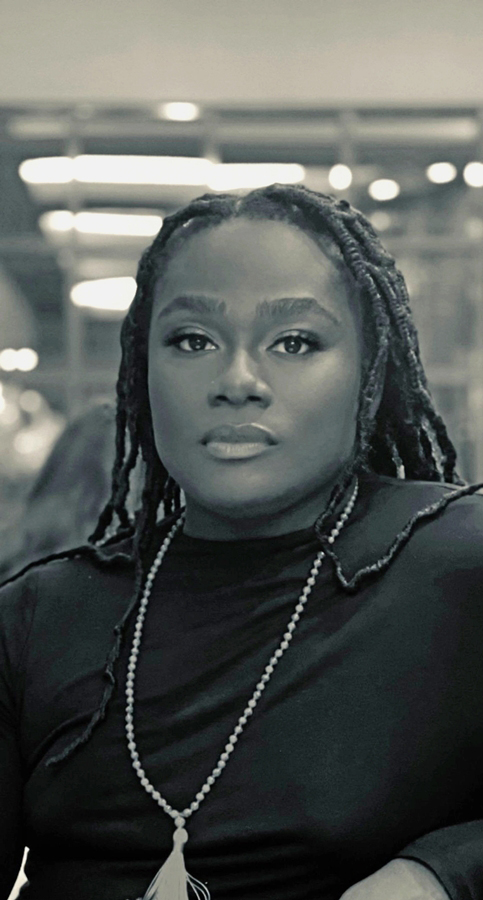
Allen grew up on Chicago’s South Side in a family one generation removed from Mississippi. “I like to say I was born up South,” she says. She traces her earliest sense of language to the way people spoke and interacted in the Black communities where she grew up. “The culture, the way we engage each other — I consider it the first type of poetry.”
Allen is a writing fellow at the Fine Arts Work Center in Provincetown, where she is developing two poetry manuscripts that explore different dimensions of language, history, and collective memory.
The first, DRILL, examines institutions that shape contemporary life — policing, incarceration, and military doctrine among them — while tracing what Allen calls the “afterlife of slavery,” a phrase coined by scholar Saidiya Hartman to describe how slavery’s structures continue to shape the present. Allen says the project reflects how that history remains embedded in many of the institutions that organize life in the U.S. today. “We’re not so removed from history or each other,” she says. “A lot of what we experience now is still informed by those structures.”
In many of the poems, Allen borrows the language of institutions themselves, juxtaposing the blunt vocabulary of legal and bureaucratic documents with lines of rhythmic, incantatory verse.
The title poem in the manuscript, “DRILL,” adopts the structure of a legal resolution, repeating the word “Whereas” as each clause gathers fragments of history, family memory, and protest. The poem includes several voices at once — from a U.S. Army training manual to Chicago drill rap (the hard-edged style of hip-hop that emerged on the city’s South Side), and personal recollection — allowing institutional language and her experience to tangle on the page.
In the poem, a question recurs: what does Allen’s nephew want to be when he grows up? The answers shift until the response finally narrows to a single word: “alive.”
Allen traces her relationship with poetry to spoken-word traditions and hip-hop. As a teenager she watched performances on Def Poetry Jam and the youth poetry competition Brave New Voices, where poets like Patricia Smith and Sunni Patterson first caught her ear. “That drumbeat is in my blood,” Allen says. “That type of listening.”
Allen sometimes describes herself as a “conjurewoman of letters,” a phrase that reflects how she understands poetry as a practice of calling memory, ancestry, and historical presence into language. Within African-American spiritual traditions such as Hoodoo and root work, practitioners sometimes describe a “two-headed” way of seeing — one consciousness grounded in the visible world and another attuned to the spiritual one.


