
Leslie Bohnenkamp’s “Works from the 1970s and 1980s”

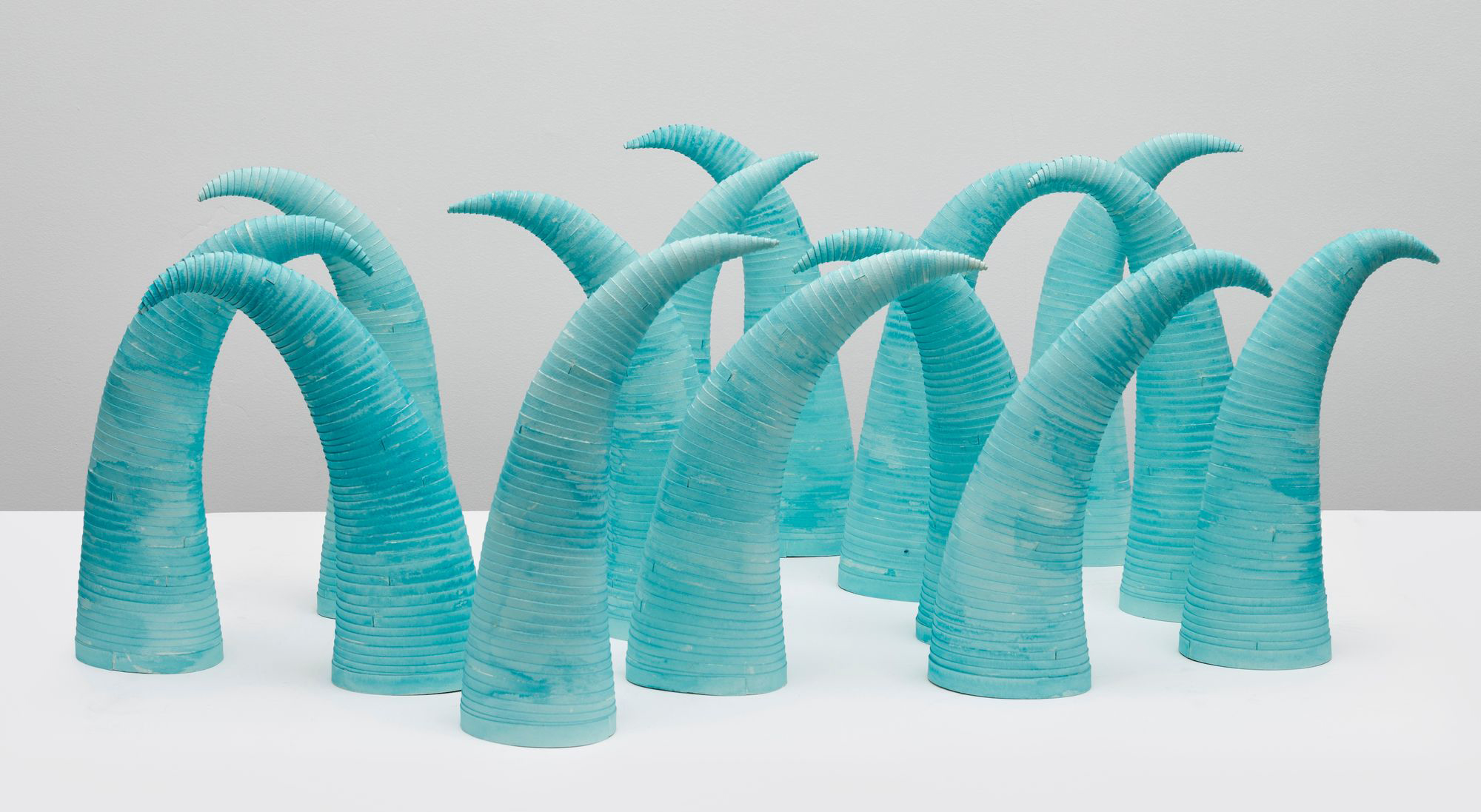
Leslie Bohnenkamp, Blue Ice Herd, ca. 1979. Watercolor on coiled paper; fourteen sculptures, each approx. 20.3 × 7.6 × 32.4 cm.
Courtesy of Donald Ryan Gallery, New York.
Sometime in the seventies (no-one can remember precisely when), Leslie Bohnenkamp dedicated a solo show at Gimpel & Weitzenhoffer to work made of offcuts from a belt factory on Canal Street. One evening a few years prior, walking back from drinks at Fanelli’s, he had come across mountains of coiled industrial paper: long strips that had been placed beneath leather belts to protect the factory’s wooden presses. He scooped up as much as he could and brought it back to his boyfriend’s apartment. Over the next two years he returned periodically for the factory’s trash, charming the owner, and creating thousands and thousands of conical paper forms. Bohnenkamp is situated as a lesser-known minimalist in this exhibition at the new Donald Ryan Gallery, which presents a selected survey of these works, including sculpture, drawings, floor pieces, and small wall hangings.
In Blue Ice Herd (ca. 1979), fourteen one-foot-high conical paper sculptures are arranged on the gallery floor, each a mottled shade of baby blue. The watercolor is applied lightly, leaving elements of the belt factory paper visible. That industrial material is countered by the distinct character of each member of “the herd” (as Bohnenkamp called it): the tips of their conic forms bend at slightly different angles, giving them a kind of organic appearance that invites fantasies of animism; I think of the oceanic desire that led sailors to invent mermaids from the fins and stomachs of dolphins. The artist himself often used maritime language for his coiled paper sculptures, sometimes describing them as shells, other times as waves. Having served in the Navy, stationed in Okinawa before being dishonorably discharged for soliciting a commanding officer, there is a trace of the water, its distended swelling, captured in his ginger arrangements.
Bohnenkamp’s work is playful and imprecise—he’s less interested in the minimalists’ “constant, known shape,” or the “obdurate identity of a material,” than in craft, and an inherent contingency reminiscent of Eva Hesse’s work, which Bohnenkamp greatly admired. The herd pieces specifically feel in lineage with Hesse’s Repetition Nineteen III (1968)— another iteration of the serial form, like Bohnenkamp’s, irregular and without hard edges, leaving traces of the hand. These affinities are aided by the display at Donald Ryan, an Upper East Side living room turned gallery. On the hardwood floors, flanking a lavish built-in fireplace, the pieces have a domesticity: a strange, almost lived-in sensation permeates the space. There’s something childlike to the works. They’re innocent, but also taciturn, changing moods the longer I stand with them.
When sculpting a singular curved paper work such as Coiled Form (ca. 1977), rather than serial forms meant for a herd, the artist’s technical training, honed while studying textiles at the University of Iowa, becomes clear. This tusk-like sculpture has a mathematical perfection and feels vaguely magical, sharing a visual iconography with Leonora Carrington’s surrealist hearing trumpet. Here, it is nested beneath Night Horizon 2 (1979) and Night Horizon #3 (1979), small shadow boxes made from roughly cut paper that display the moon, distantly, against a black-and-blue night sky.
Made in 1979 while Bohnenkamp was in residence at MacDowell artists’ colony, these makeshift planetariums seem intentionally raw, in contrast with the precision on view elsewhere. Their earnest, imperfect construction reminds me of the poet John Wieners who, when asked by an editor about his theory of poetics, replied, “I try to write the most embarrassing thing I can think of.”


