
Making Music for an Unexpected Choir

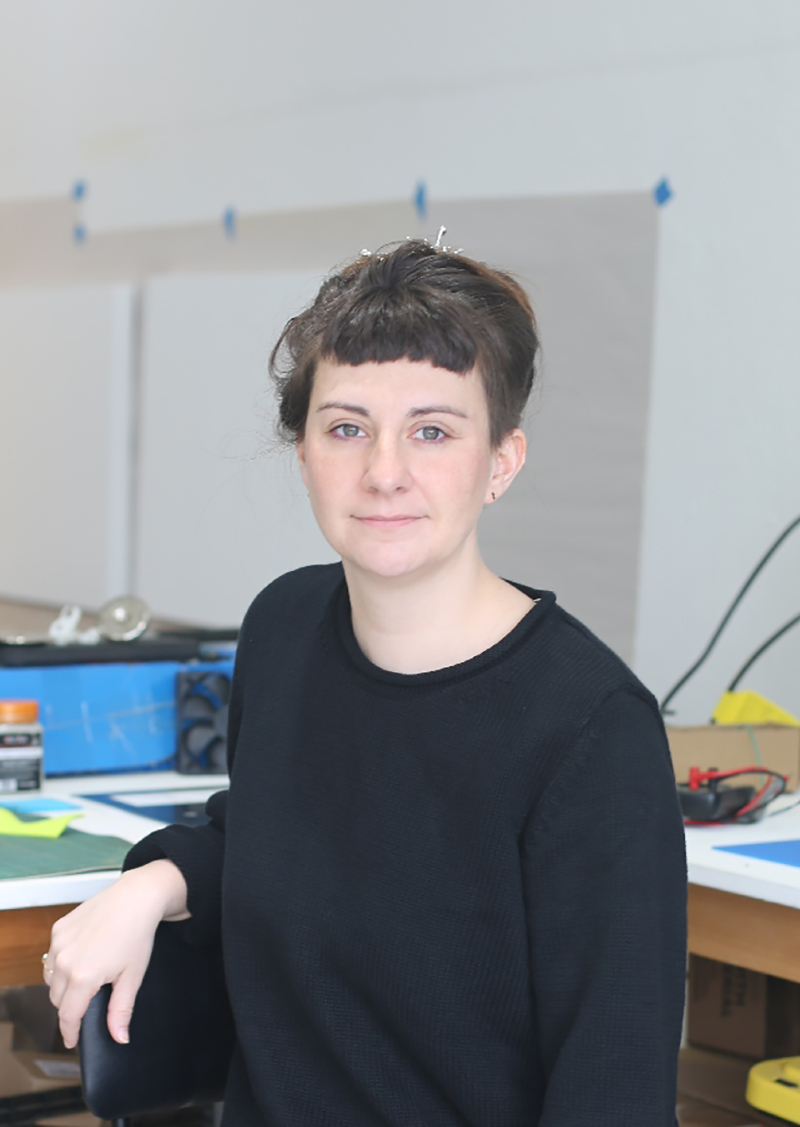
Tess Oldfield in their studio. Photo: Abraham Storer
Have you ever thought about all the little sounds your body makes as it goes about its daily work? Not the audible rumble of a stomach or the crack of an ankle, but the tiny sounds deep inside that we never hear. What about the flapping of our vocal cords that enables us to say “Hello,” or “How are you?” Then there are the interior spaces that are formed — the spaces in the mouth that are created as we speak, eat, and swallow. What do those look like? What sounds does each shape result in?
These are the types of questions that occupy sound artist Tess Oldfield, who is currently a fellow at the Fine Arts Work Center in Provincetown. “All my work is situated within this obsession I have with reconstructing the human vocal system,” says Oldfield. “How do I ‘Frankenstein’ all these microsounds that are constantly happening?” In their work, Oldfield combines the technical, visual, and musical to bring these vocalizations outside the body, give them form, and make them audible. Essentially, this results in the creation of musical instruments.
Oldfield’s interest in sound and music goes back to their childhood in New Jersey. For all 12 years of grade school, Oldfield was part of a touring choir. In high school, they sang 40 hours a week, and they began college pursuing vocal performance. “It’s really where all my work emerges from,” says Oldfield.
In their early 20s, however, Oldfield put life “on hold” for a time and began taking ceramics classes as a way to find a community. This led them to pursue an undergraduate degree in ceramics; during college, music began to creep back into their life. They became interested in the idea of visualizing sounds through light — casting light through very thin porcelain forms and coding them to resemble mouths.
As an M.F.A. student at the Rhode Island School of Design in the digital media department, Oldfield delved deeper into the world of sound and technology, learning about coding, DIY hardware, and kinetic sculpture. This was when Oldfield began work on the first iteration of a project that still occupies them today, an installation piece titled “Pitch Pipe Choir.”
Pitch pipes, Oldfield says, are the paraphernalia of singers — small, round, harmonica-like objects that include one octave of notes and give the starting pitch of a song. “It’s a tool, not an instrument, but I am interested in making it an instrument,” Oldfield says.
Two different pitch pipes are made by a company called Kratt, which happens to operate out of Edison, N.J., not far from where Oldfield grew up. The pitches these two pipes produce are similarly aligned to treble voices. “I’m interested in that,” says Oldfield, “because I’m interested in composing music that is related to my memories of singing in children’s choirs.”


