
Making Unlikely Images From Bits of the Ordinary

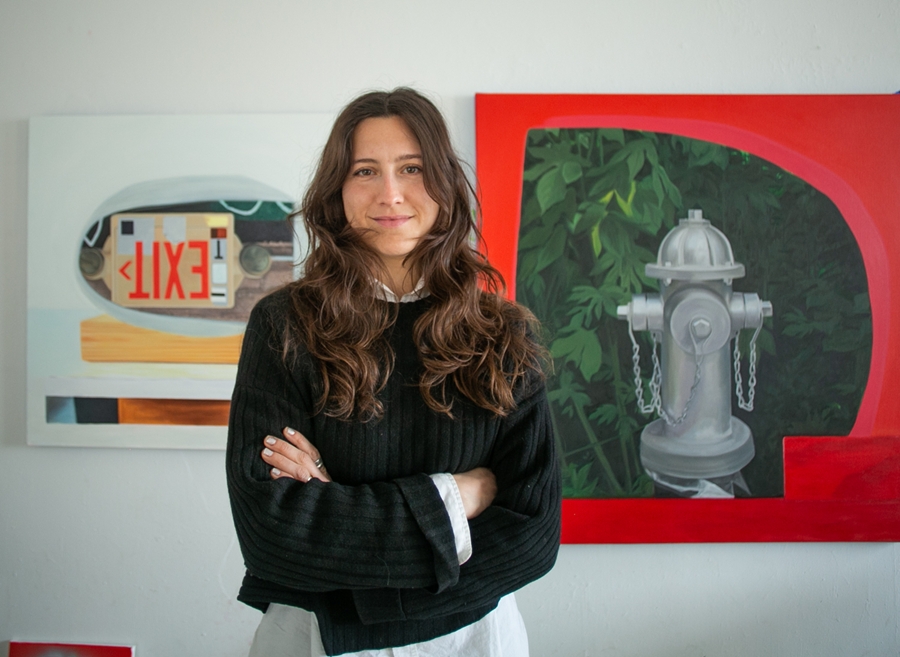
Calhan Hale is a visual arts fellow at the Fine Arts Work Center. Photo: Agata Storer
Calhan Hale’s studio exudes the same gentle ease and summery daze as her oil paintings. The space is strewn with snippets of images — flower fragments, exit signs, particle board, a broom, a fire hydrant, a rock cracked open to reveal waxy emerald leaves.
Hale’s recent work is a study in unlikely cohabitants. “I’m always trying to find ways to de-contextualize and re-contextualize elements from my surroundings,” she says. Untethering familiar objects, textures, images, or signifiers from the environments in which they are situated, she creates alien vignettes from fragments of the ordinary. Her paintings mirror the cheerful calm and lucid curiosity of their creator, unconcerned with their own idiosyncrasies.
Her process begins with collecting images. “I’m always taking pictures,” she says, “just on my phone. Sometimes it’s something I’ve passed many times. It suddenly catches my attention, and I’m not sure why.” She prints the images, cuts out specific elements, and affixes them to the wall with blue painter’s tape, which allows her to rearrange the layers.
Her studio wall at the Fine Arts Work Center in Provincetown, where she is currently a visual arts fellow, is speckled with slices of color — hot orange-red bursting through honey-tinted wood grain and swathes of robin’s egg blue. “Eventually, some kind of relationship emerges, and I find myself at a distance from the image that I took,” says Hale. “I become surprised by this thing that I already knew. And that’s how I know that it’s a good place to start a painting.”
This slow dissection of the act of looking has underpinned Hale’s artwork for as long as she can remember. While she refined this way of working in her M.F.A. program at Columbia University, which she completed last year, Hale has always been interested in what it takes to really see her physical surroundings — to strip back the layers of cultural meaning and face the colors and forms beneath for what they are.


