
Michael Waugh’s Warnings

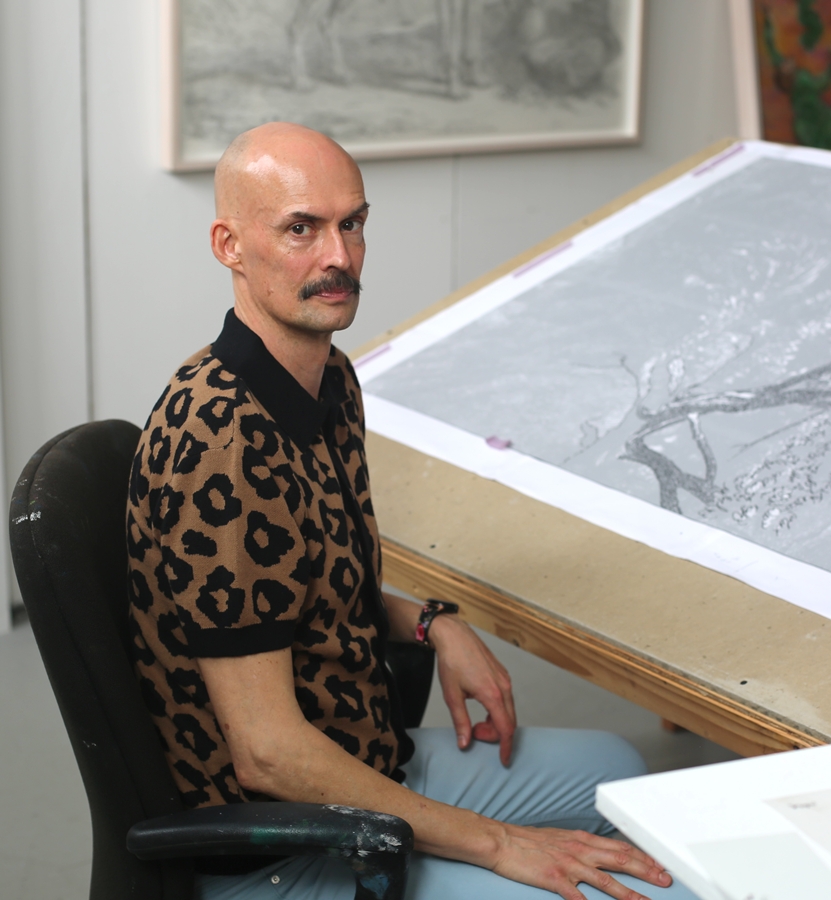
Michael Waugh in his studio at the Fine Arts Work Center. On his desk is a work in progress created with words from the Jan. 6, 2021 report. Photo: Abraham Storer
The large drafting table in Michael Waugh’s studio at the Fine Arts Work Center in Provincetown is covered by one panel of an in-progress triptych. A larger black-and-white print of a landscape is visible through the transparent matte surface of a layer of Mylar. A tree branch in the foreground appears to be loosely sketched on the Mylar in black ink. On closer inspection, it becomes apparent that the tree is rendered in words: “evidence,” “unequivocally,” “impact,” and “president” are among them. Two male figures at the top right are having an erotic encounter.
Waugh, one of this year’s visual arts fellows at FAWC, works in a tradition of micrography — using text to create an image. The words that make up his images are a mix of cursive and block lettering in different sizes. There are sharp angles, big swoops, and exuberantly crossed “t”s.
Waugh is working with the text of the report on the Jan. 6, 2021 riot at the Capitol. Photocopied pages sit next to his worktable with words that he’s already used crossed out. Sometimes he places a word for formal reasons, like needing a curve to make something legible. Waugh will finish this drawing with individual words, whole phrases, and complete sentences from the report’s summary. The order will be scrambled, but he’ll be certain to use every word.
Waugh has been working on this drawing for five months and expects to finish it in November. The work is tedious and time-consuming, an affront to the productivity-driven art market. “If the forces out there are trying to convince artists to make quick gestural work, to crank it out, I’m going to make work that takes me a year,” he says.
Reading and political engagement are important parts of Waugh’s process. Historical and legislative documents often serve as his source material. “These texts share a kind of cultural opacity,” he says. Micrography is his way of “authentically portraying something about the opacity of these texts in our culture.”
Political figures who lie have been on Waugh’s mind recently, so he turned to the Jan. 6 report. “Reading page after page after page of testimony, even the summarized version, it’s just like, how could anybody believe this isn’t true?” he says. “How could half the country believe that there are questions about who won the election?”
In Best Practices, a drawing of a Landseer dog and a scythe, Waugh worked from a text about another case of purported election fraud. The Obama-era report from the Election Administration Commission concluded that there was no fraud in the 2012 Minnesota and Missouri Democratic primaries, which many people, including Donald Trump, claimed were fraudulently won by Obama. The study recommended that there should always be a paper trail to confirm votes. The recommendations were followed in 2016 and then in 2020.


