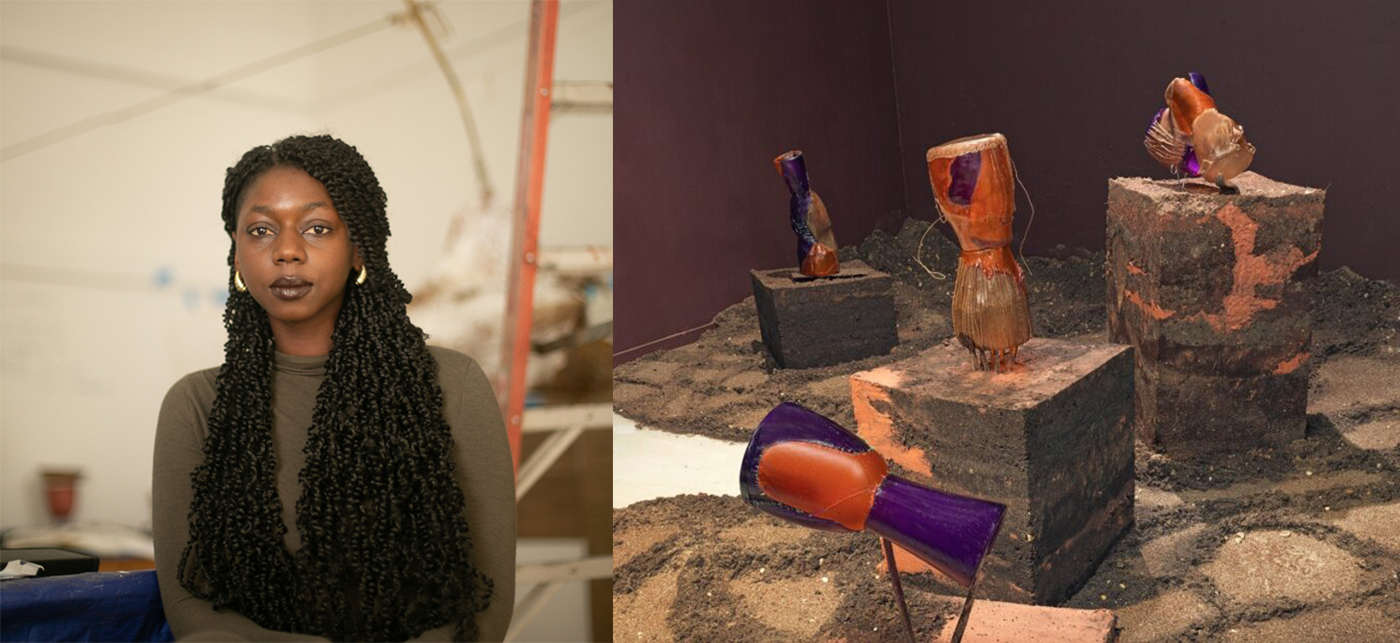
The first thing a visitor sees in Yacine Tilala Fall’s studio at the Fine Arts Work Center is a drum near the ceiling hanging by a lattice of cords. From the drum’s center, a strip of hide drops like an umbilical line into an inverted cow stomach, propped open with willow twigs. Salt has bloomed across the surface in pale crusts to cure it.
Fall, a visual art fellow at FAWC, is working on the sculpture for her upcoming exhibition, opening Feb. 20. Like this piece, much of Fall’s recent work uses animal tissue, leather, clay, sutures, and rope. Often, she incorporates her sculptures into performances or installations.
Fall found the drum, from a set of timpani, online. It was in Plymouth, where two women had used it for years as a coffee table. Fall loved the round, bottomless shape. She grew up in a Senegalese Muslim household in Washington, D.C. and Florida and draws from her ancestry and culture in her artwork. A drum, central to West African culture, means something very different in New England than in Senegal.
“Drums circulate with a particular vagueness,” she says. People inherit them, give them away, lose the chain of stories. “I was curious about why it ended up here,” she adds.
Fall dislodges the drum in this sculpture from its ornamental life. It hangs above the inverted cow stomach, an anatomical chamber that reads as womb and intestine at once; the drum becomes a comparable body, shaped by skin and tension. By suspending those two interiors side by side, Fall disrupts what viewers expect organs and instruments to be. The objects, both having been discarded, become things that Fall stewards, introducing questions of who gets to handle material, how it is processed, and what gets erased when it becomes a decoration or ornament.