
The Origin Story We Need: A conversation with Rebecca Gayle Howell

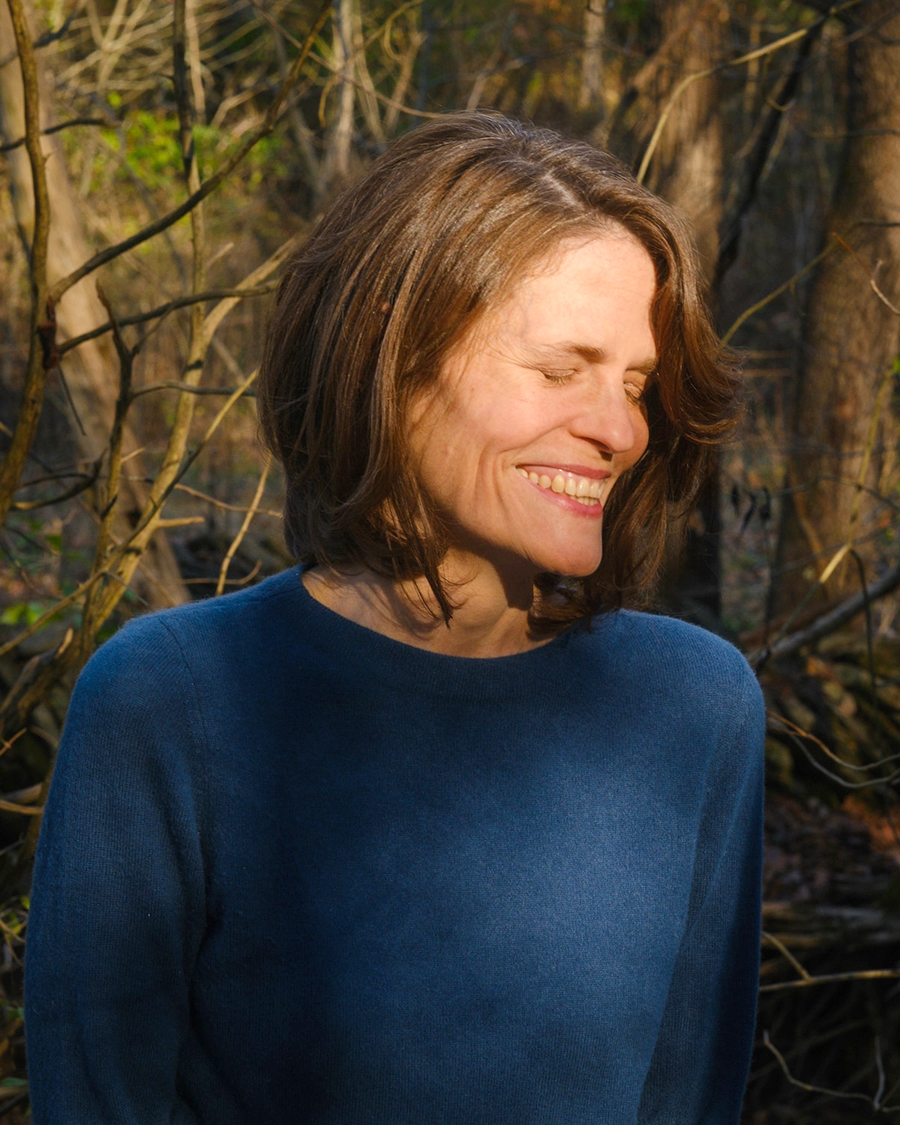
Rebecca Gayle Howell. Photo: Carey Neal Gough
Rebecca Gayle Howell created her latest book, Erase Genesis, by repeatedly erasing sections of the first three chapters of Genesis, finding new combinations as she worked, by hand, with blue watercolor and a brush. In the poems she finds there, we are reconciled to the natural world; if there is a separation, the book makes clear, the call is coming from inside the house: “And the same / man / commanded / man should / be alone” reads one poem excerpted in this magazine. These poems feel like an invitation to see an old story anew. Rebecca and I talked about her process, the deep mystery of creative work, the necessity of quiet, and the process of listening to the work as it calls itself into being.
Martha Park: For people who haven’t yet seen Erase Genesis, could you talk about your process and how you found your way into the book?
Rebecca Gayle Howell: The inciting event was that I had a commission on my desk to write a poem for my friend Marcus Wicker. He was the poetry editor at the Southern Indiana Review, and he was leaving that post, and they were putting together an issue to celebrate his role as editor and his work as a poet. He and I know each other from the Fine Arts Work Center. We were there together. That was the first time I ever lived outside of the state of Kentucky, and it was a very dramatic awakening to the very dramatic landscape of Provincetown. I was reading a lot about climate change, while I was there, and I was writing Render, and I had my soulmate dog with me, whose name was Key. She and I would walk a lot around Land’s End, and I’d be thinking about how I was walking in a Brigadoon, like in a place that probably wouldn’t exist when ocean levels began to rise. So these are the kinds of thoughts that I had when I was returning in my heart to my love and respect for Marcus. He’s also a contemplative Christian—we share that as well. When I came to the text, I thought I would be finding one poem. And the more I worked, the more I realized that the poems wanted to compile into telling a story.
Martha: As part of that process, how did you find yourself reaching for Genesis in particular?
Rebecca: It’s difficult to tie together in a kind of clean logic. You know, I’m interested in mystery, and I’m interested in how poetry can take us into new understanding and to new experience that we haven’t yet imagined. And so when I’m working, I try to listen to my intuition and to what feels alive, you know. So when I was writing Render, often I would get a little clip of language in my ear, and I would just follow it until the next clip came. And that taught me how I want to pursue my practice of poetry.
The work will tell us what it wants to be if we listen. And that’s been my experience. So thinking about that connection that I have with Marcus, in our faith and in that place, it just felt right to come to Genesis. It’s also true that the book that underpins the scholarly questions I have in Erase Genesis is a book that I was reading while I was there in Provincetown the first time: Ellen F. Davis’s Scripture, Culture, and Agriculture: An Agrarian Reading of the Bible, in which she makes it clear that that King James Version translation of awarding us dominion over the earth is an inaccurate translation.


