
Ty Raso Writes Through Refraction

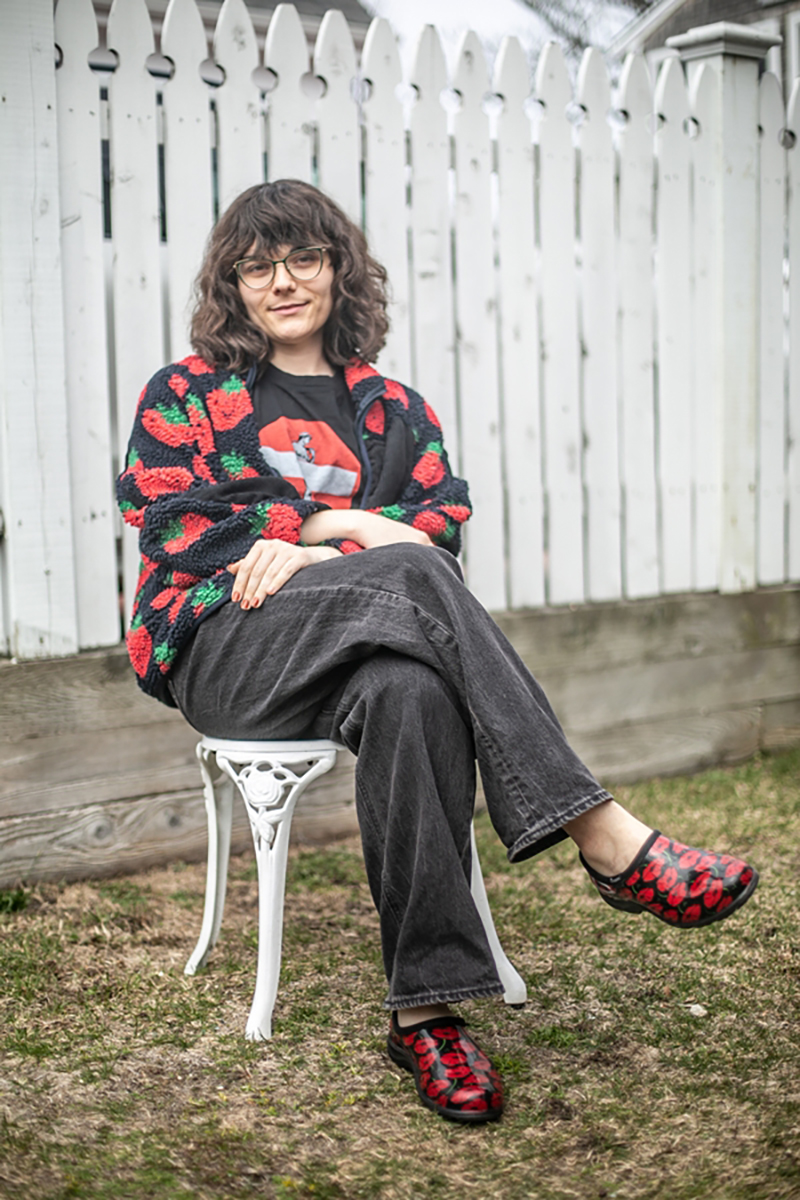
Ty Raso is a second-year writing fellow at the Fine Arts Work Center. Photo: Agata Storer
Ty Raso returns to the same material until it changes shape. A line, an image, a fragment of memory reappears across drafts until it begins to behave differently. “Inevitably you’ll surprise yourself,” she says, “if you keep thinking about the same thing enough.”
Raso started writing her first book of poems nearly seven years ago. The page became an early place to explore transformation, both literary and personal. “In the context of a poem, I can create any kind of body,” says Raso, who is trans. “It couldn’t be interrupted by the external world.”
That idea runs through both of her recent projects: Mirror Would Be a Beautiful Name for a Child, which will be published by Noemi Press in 2027, and Light Pretending to Be Light, the manuscript she is currently working on during her second fellowship at the Fine Arts Work Center in Provincetown. Raso’s work has previously appeared in Poetry, The Offing, and Black Warrior Review, and she is also the author of the 2026 chapbook no seed yes seed.
Mirror began as her M.F.A. thesis at Indiana University. By the time she arrived at FAWC for her first fellowship in 2023, she had stopped believing that pain should justify the work. “I think I was being cruel to myself,” she says, “and cruel to the reader.” The material was worth keeping, she decided, but perhaps the tone wasn’t.
During that first residency, Raso loosened up. She began writing with an “ethos of play,” giving herself permission to move by sound and sudden leaps in feeling. She made more room for what felt true to her, including pop culture and humor, and let the poem follow its own associative drift.
That ethos of play can be felt in “Ty Gets a Boyfriend,” from Mirror. In it, Cary Dubek from the sitcom The Other Two appears alongside a romantic memory, a father wound, and a line that captures Raso’s knack for mingling humor and grief: “The dad-shaped hole/ in my clavicle whistling when I/ remember too quickly.” The poem carries the tonal range Raso wants. “I want a reader to come away thinking, ‘That was kind of funny — that was kind of sad,’ ” she says. She strives for “a very complex joy.”


